
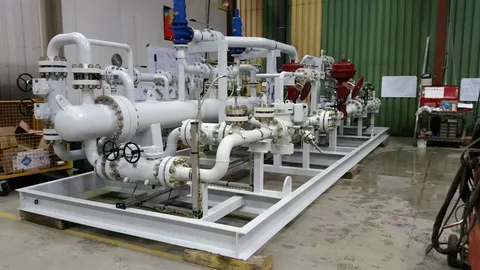
When people picture the machinery behind a working plant, they think of the big stuff: boilers, compressors, rows of tanks stretching to the fence line.
The pump gets a nod, maybe, then fades into the background. That’s backwards. The pump is where most of the money and most of the trouble live.
And within that world, one design keeps earning its keep in tight refineries, crowded chemical skids, and retrofitted power plants: the inline pump. It sits vertically in the pipe run, takes up almost no footprint, and does work that horizontal machines struggle to match.
So why does this specific style of pump matter so much right now?
Pumps Are Where the Energy Bill Actually Lives
Talk to anyone running a plant floor and they’ll tell you the electricity meter never sleeps. What’s less obvious is which machines are spinning it the fastest. It isn’t the lighting or the HVAC. It’s the motors, and specifically the motors driving pumps.
According to Pumps & Systems, motor-driven systems consume 70 percent of all electricity used in the U.S. industrial sector, and motor-driven pumps alone account for more than 30 percent of that total, more than any other single application. That’s not a rounding error. That’s the biggest single lever a plant manager has on operating cost.
The same source notes that pairing centrifugal pumps with variable frequency drives in low-head applications typically delivers substantial energy savings, often cutting consumption dramatically on the machine that already dominates the bill. That math is why efficiency conversations keep circling back to pump selection, not to some new gadget bolted on later.
The Inline Design Solves Problems Horizontal Pumps Create
The classic horizontal centrifugal pump works. It also eats floor space, needs a heavy baseplate, demands careful shaft alignment between pump and driver, and forces the piping to bend around it. On a crowded skid, every one of those is a headache.
An inline pump flips the geometry. Suction and discharge sit on the same centerline, so the pump drops straight into the pipe run like a valve. That single change ripples through the whole install:
- Smaller footprint. The pump lives in the piping, not next to it, which frees up floor and cuts structural steel.
- Simpler piping. No offset elbows to route around a horizontal casing means fewer welds, fewer gaskets, and fewer leak paths.
- Easier alignment. Close-coupled inline designs remove one of the classic failure modes on rotating equipment before the pump ever ships.
- Retrofit friendliness. Swapping in an inline unit during a turnaround is often the fastest way to modernize an aging line without rebuilding the whole bay.
For a deeper look at how the geometry works and where it fits, this primer on inline pumps walks through the mechanics without the sales pitch.
Standards Do More of the Heavy Lifting Than People Realize
Buyers sometimes treat pump standards as paperwork. They aren’t. They’re the reason a pump you spec today still fits the plant three revamps from now.
The dominant standard for hydrocarbon service is API 610, which sets minimum requirements for centrifugal pumps used in petroleum, petrochemical, and natural gas process services. The document is updated on roughly a five-year cycle, which means engineers should already be thinking about the next revision.
One provision worth calling out: under the current edition, pumps must be capable of a meaningful head increase at rated flow through a larger impeller, variable-speed capability, or a blank stage. That’s the standard forcing designers to leave room for the plant to grow.
Ignore that clause and you’ll spec a pump that maxes out the day production creeps up.
The Two Enemies Every Plant Underestimates
Ask a reliability engineer what actually kills pumps and you’ll hear two words over and over: contamination and cavitation. Both start out invisible and get expensive fast.
Water in bearing oil is the classic sneaky problem. As little as 0.002% water in the lubricant can cut bearing life by 48%, and 6% water drops it by 83%, according to Maintenance World. You will never see that with the naked eye. You will see it on the maintenance report six months later, framed as a bearing failure that looked random.
Cavitation is the other silent tax. When suction conditions drop below the fluid’s vapor pressure, part of the flow flashes to vapor and collapses violently against metal. The result is lower hydraulic efficiency because part of the fluid is acting as vapor, higher energy consumption to move the same volume, and shortened life on the impeller, casing, and seals.
None of that shows on a nameplate, but all of it shows on the P&L.
Specifying an Inline Pump Without Regretting It Later
The tempting move is to size the pump for today’s duty point and call it done. The better move is to size for the operating envelope you run in practice, not the one on the datasheet.
- Map the real duty curve. Plants rarely run at rated flow. Look at how many hours per year the pump sits at part load versus full load and pick a hydraulic that’s efficient across that band, not only at BEP.
- Pair with a VFD where head is low. If the system curve is friction-dominated at part load, variable speed pays back fast on the power bill.
- Design suction, not just discharge. NPSH margin is where cavitation is won or lost. Straight pipe upstream matters more than most engineers admit.
- Plan the seal environment. Flush plans, buffer fluids, and vent lines aren’t afterthoughts. They’re the difference between a five-year seal and a five-month one.
- Keep the standard in your back pocket. Even if the service isn’t strictly API, borrowing its rules on head margin, materials, and mechanical run tests is cheap insurance.
The inline pump won’t fix a badly designed system. Nothing will. But when the piping is tight, the footprint is expensive, and the duty is honest, it’s often the machine that makes the rest of the plant look good and keeps the biggest line on the power bill under control.

