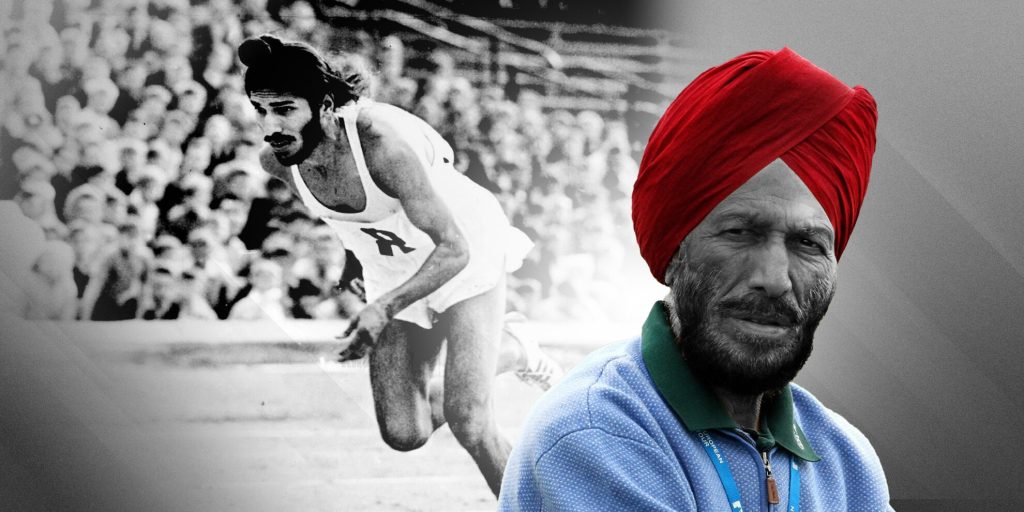
In the history of India sport, few names resonate as strongly as Milkha Singh. His life, shaped by loss and forged through sheer will, became a symbol of athletic excellence long before sports science or sponsorships entered the Indian vocabulary. To understand where Indian sprinting stands today, one must begin with the story of Milkha Singh—a man who, against all odds, outran his past and led generations toward a different future.
From Partition to Podium: The Making of the Flying Sikh
Milkha Singh was not born into a life of sport or privilege. His early years were scarred by the violence of Partition in 1947. He lost his family in the riots and fled to India as a teenager with little more than his determination.
It was the Indian Army that spotted his raw speed. Recruited into the services, Singh’s initial runs were modest—barefoot laps during morning drills. But the Army soon recognized his potential and provided him the structure and routine he lacked. That routine, as Singh later described, was the start of everything. It gave him discipline, and it gave Indian athletics a legend.
The Achievements That Put India on the Track
By the late 1950s, Milkha Singh had become a household name. His performance in international meets stunned critics and fans alike. Among the most noteworthy achievements of Milkha Singh:
- Commonwealth Games, 1958 – Gold in 440 yards, the first Indian to do so.
- Asian Games, 1958 – Gold in 200 m and 400 m.
- Rome Olympics, 1960 – Fourth place in 400 m, missing bronze by 0.1 seconds, but setting a national record of 45.73 s.
That last number stood untouched in India for nearly four decades. More importantly, it redefined what Indian athletes could aspire to achieve globally.
Sprinting, Then and Now: What’s Changed?
Milkha trained without a coach in the traditional sense. He studied his competitors’ movements and built his own drills. Today’s athletes work in environments equipped with high-speed cameras, sports psychologists, and biomechanics labs.
Example: National Institute of Sports, Patiala
This premier athletics hub in Punjab—incidentally, where Milkha Singh later mentored athletes—now offers sprint lanes with electronic timing gates, recovery ice baths, and altitude simulation rooms. It’s a far cry from the open fields where Singh clocked his early lap times.
Current Contenders: Who Carries the Baton Now?
Indian sprinting, once synonymous with Milkha Singh, has started to diversify. While long-distance running and field events like javelin (hello, Neeraj Chopra) dominate headlines, the sprint circuit is seeing fresh talent emerge.
Hima Das: Dhing Express
In 2018, Hima Das became the first Indian woman to win a track gold at a global event—the World U20 Championships in 400 m. Her rise from rice fields in Assam to world podiums mirrors Singh’s arc from refugee to Olympian. Both ran for something more than medals.
Amlan Borgohain and Dutee Chand
The names may not have Milkha’s media gravity yet, but they’re shaving seconds off national records. Borgohain recently clocked 20.55 s in 200 m, while Dutee Chand has twice qualified for the Olympics.
All train under tightly structured regimes—altitude exposure, recovery protocols, and biometric assessments. Still, they share Singh’s emphasis on personal routine and mental grit.
What India Must Fix to Run Faster
While raw talent exists, it’s not always matched with opportunity. That gap between ability and access is where Milkha Singh’s lessons remain relevant.
Grassroots Access
Milkha emerged without a track, a coach, or support. Many young Indians today still face that same scenario. States like Odisha and Haryana have invested in sports academies, but tier-2 towns and villages remain underserved.
A young sprinter in Kolhapur may clock sub-11 second 100 m sprints, but without district meets, coaching or equipment, progress stalls.
Coaching Ecosystems
India lacks sprint-specific mentorship pipelines. We have national coaches, but few former sprinters are groomed into coaching roles. Milkha Singh, after retirement, personally mentored athletes at NIS Patiala—a tradition we’ve let fade.
Competition Exposure
No athlete improves without competing regularly. Singh competed internationally across continents. Today, only a few Indian sprinters are funded to attend high-profile meets abroad. Budget constraints and federation red tape slow progress.
Why Milkha Singh Still Matters
In many Indian training centers, his photograph still hangs beside the track. Not for nostalgia, but as a reminder of what was—and what could be.
Milkha didn’t have access to nutrition plans or pre-race ice baths. But he had something athletes still need: a mindset that refused to break. That mindset is not easy to teach, but it’s easy to show. His life is the example.
To this day, aspiring athletes in military academies or small-town schools read the story of Milkha Singh not as history, but as possibility.
Media, Betting, and Modern Fan Engagement
As sprinting gains audience attention, digital fan platforms have also emerged. Fantasy games, prediction platforms, and even analytics apps now accompany athletic events.
One example is Dbbet, a platform offering match stats and performance trends across Indian and global sports. For those tracking medal prospects or sprinting timelines, tools like this add a data-backed layer to fan engagement.
What the Future Might Hold
Will India produce another Milkha Singh? Maybe not in the same mold—but potentially in the same spirit.
Focus Areas for the Next Decade:
- Track Infrastructure: High-quality lanes, electronic timing, and recovery stations across every state.
- School Programs: Annual inter-school sprints with scholarships for winners.
- Coach Development: Retired athletes transitioning into paid, certified coaching roles.
- Media Visibility: Broadcasting regional track meets on sports channels or digital platforms.
Conclusion: Legacy in Motion
Milkha Singh didn’t just win races. He changed expectations. He showed what could be done with willpower and 400 meters of grit.
Today, as India sport evolves—with better facilities, more competitions, and growing global participation—it still needs the essence of Milkha: the daily run, the focused mind, the refusal to stop. His was not just a sprinting career—it was a blueprint.
And for every Indian sprinter waiting for a lane, that blueprint is still the best way forward.